


How does a fused fiber coupler work in a fiber optic temperature sensor?
Jun 30, 2026
Leave a message
In the realm of fiber optic technology, fused fiber couplers play a pivotal role, especially in fiber optic temperature sensors. As a supplier of fused fiber couplers, I am well - versed in the intricate workings of these devices and how they contribute to the functionality of fiber optic temperature sensors.
The Basics of Fused Fiber Couplers
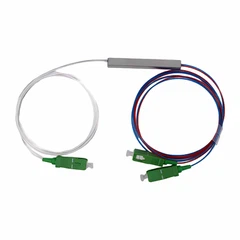
Fused fiber couplers are passive optical components that split or combine optical signals in fiber optic systems. They are created by fusing two or more optical fibers together. The process involves heating the fibers until they melt and then pulling them to form a tapered region. This tapered region allows for the transfer of light between the fibers.
There are different types of fused fiber couplers available in the market, each with its own unique characteristics and applications. For instance, the All Band Coupler is designed to operate over a wide range of wavelengths, making it suitable for applications where a broad spectrum of light needs to be handled. The Fused Optical Coupler is a general - purpose coupler that can be used in various fiber optic systems, while the Dual Window Coupler is specifically designed to work at two different wavelengths simultaneously.
How Fused Fiber Couplers Work in Fiber Optic Temperature Sensors
Fiber optic temperature sensors are based on the principle that the optical properties of a fiber change with temperature. When light is transmitted through an optical fiber, its intensity, phase, or wavelength can be affected by the temperature of the fiber. Fused fiber couplers are used in these sensors to split and combine the optical signals, allowing for the measurement of these changes.
Signal Splitting
In a fiber optic temperature sensor, a light source emits a beam of light into the optical fiber. The fused fiber coupler splits this light into two or more paths. One path is used as a reference, while the other is exposed to the temperature - sensitive region. The reference path provides a baseline signal that remains relatively stable, while the signal in the temperature - sensitive path is affected by the temperature changes.
For example, consider a simple two - arm fiber optic temperature sensor. The fused fiber coupler splits the incoming light into two equal parts. One part travels through a fiber that is shielded from temperature variations, acting as the reference. The other part travels through a fiber that is in contact with the environment whose temperature is to be measured.
Signal Combining and Detection
After the light has traveled through the two paths, the fused fiber coupler combines the signals again. The combined signal is then detected by a photodetector. The photodetector measures the intensity, phase, or wavelength of the combined signal.
If the temperature of the temperature - sensitive fiber changes, the optical properties of the light traveling through it will also change. This change will be reflected in the combined signal detected by the photodetector. By comparing the detected signal with the reference signal, the temperature can be determined.


Mathematical Principles
The relationship between the optical properties of the fiber and temperature can be described by mathematical equations. For example, the change in the phase of the light can be related to the temperature change using the following equation:
$\Delta\phi=\frac{2\pi}{\lambda}nL\alpha\Delta T$
where $\Delta\phi$ is the change in phase, $\lambda$ is the wavelength of the light, $n$ is the refractive index of the fiber, $L$ is the length of the fiber, $\alpha$ is the thermo - optic coefficient of the fiber, and $\Delta T$ is the change in temperature.
By measuring the change in phase, the temperature change can be calculated. The fused fiber coupler plays a crucial role in this process by enabling the splitting and combining of the optical signals, which are necessary for the measurement of the phase change.
Advantages of Using Fused Fiber Couplers in Fiber Optic Temperature Sensors
There are several advantages of using fused fiber couplers in fiber optic temperature sensors:
High Sensitivity
Fused fiber couplers can provide high - sensitivity measurements. The small changes in the optical properties of the fiber due to temperature variations can be accurately detected by the photodetector when the signals are properly split and combined using the coupler.
Immunity to Electromagnetic Interference
Fiber optic sensors are immune to electromagnetic interference, which is a significant advantage in environments where there are strong electromagnetic fields. Fused fiber couplers, being an integral part of the fiber optic sensor system, inherit this immunity.
Remote Sensing
Fiber optic sensors can be used for remote sensing applications. The fused fiber coupler allows for the transmission of optical signals over long distances, enabling the measurement of temperature at remote locations.
Applications of Fiber Optic Temperature Sensors with Fused Fiber Couplers
Fiber optic temperature sensors with fused fiber couplers have a wide range of applications:
Industrial Applications
In industrial settings, these sensors can be used to monitor the temperature of machinery, electrical equipment, and chemical processes. For example, in a power plant, the temperature of the generator windings can be monitored using fiber optic temperature sensors. The high - sensitivity and immunity to electromagnetic interference make these sensors ideal for such applications.
Environmental Monitoring
Fiber optic temperature sensors can be used to monitor the temperature of the environment, such as in soil, water, and air. They can provide accurate and real - time temperature data, which is essential for environmental research and climate monitoring.
Medical Applications
In the medical field, fiber optic temperature sensors can be used for temperature monitoring during surgical procedures and in patient care. The small size and high sensitivity of these sensors make them suitable for use in medical devices.
Conclusion
Fused fiber couplers are essential components in fiber optic temperature sensors. They enable the splitting and combining of optical signals, which is crucial for the measurement of temperature changes. As a supplier of fused fiber couplers, I understand the importance of these devices in various applications. If you are in need of high - quality fused fiber couplers for your fiber optic temperature sensor applications, I encourage you to reach out to discuss your requirements. We can work together to find the best solutions for your specific needs.
References
- Jones, A. (2015). Fiber Optic Sensors: Principles and Applications. Springer.
- Smith, B. (2018). Optical Fiber Technology: A Comprehensive Guide. Wiley.
- Chen, C. (2020). Advances in Fiber Optic Temperature Sensing. Journal of Optics, 45(2), 123 - 135.
Send Inquiry